• Search robertedunn.com/blog
  • Unidentified Anomalous Phenomena
  • CRIME BLOG
  • Blog
  • Author
  • Pretty City Murder
  • Chapter 1
  • Contact
  • Short Stories
    • Deaf
    • Anonymous
    • Isolated
    • Apartment 19
    • Letters
    • Phantasmal
  • True Stories
    • Talk
    • Heel
    • Priest
    • Best
    • Sweet
    • Father
  • Piano
  • Servile Obedience
  • Society of St. Pius X
  • How It Happened
  • Website Stats
  • Latin Mass in History
  • Reading List
  • Mass of the Ages
ROBERT E DUNN
CATEGORIES

All | Art | Comedy | English | Faith | Film | History / Politics | Latin | Math | Music | Photography | School | Science

China bridge collapse

8/25/2025

0 Comments

 
Casey Jones, professional geotechnical engineer, USA
Total length of GG B, not a railway bridge, including approaches from abutment to abutment, plus the distance to the Toll Plaza, is 9,150 feet (approximately 1.73 miles). From deck to water the distance is about 220 to 245 feet. Workers worked at night. On May 27, 1937, the bridge was opened to the public for the first time for “Pedestrian Day”, and the middle flattened because of the massive crowd.


The Latin root for bridge is pons (or its genitive form, pontem). 
  • English pons (anatomy): This part of the brainstem is named the "pons" because it "bridges" the connection between the cerebrum and cerebellum, similar to a physical bridge.
  • English pontoon: This term refers to a flat-bottomed boat, often used for military bridges, and derives from the Latin pontem.
  • Latin Pontifex: This word, which morphed into the title "Pope", originally meant "bridge-maker" or "path-maker", possibly in reference to the bridge over the Tiber River, or metaphorically bridging the gap between earthly and divine realms.

Golden Gate Bridge
An earthquake struck the bridge before it was even completed.
​
A safety net below the bridge saved 19 men during its construction.
Fiftieth-anniversary crowds made the bridge temporarily flatten.
It took 30 years to remove lead-based paint from the bridge.
The orange color was originally intended as a primer.
Fog horns blare in different tones.​
Picture
[The photo is reverse left.]
Credit: Galen Rowell Creative #: 534286634 License type: Royalty-free Collection: Corbis Documentary Max file size: 3112 x 2123 px (10.37 x 7.08 in) - 300 dpi - 6 MB Upload date: May 24, 2016 Release info: Model released Categories: Stock Photos Golden Gate Bridge​
Picture
Dark Passage 1947 at Fort Point, still from Warner Bros., Humphrey Bogart
0 Comments

Supreme Court

8/25/2025

0 Comments

 
Picture
E PLURIBUS UNUM
Out of many, one
​
Originally, Latin letters were capital letters.
From that word, we got plural.
13 original colonies

13 berries, leaves
13 stars, arrows
​one bald eagle
symmetrical
like your body
0 Comments

1492, 1493

8/18/2025

2 Comments

 
seven months, 10 days without confession or Mass


However, in the 15th century, carrying the Eucharist was a practical necessity for Catholic seafarers. Christopher Columbus was deeply religious, and his three ships, the Niña, the Pinta, and the Santa Maria, very likely carried Him as part of their standard provisions.


​Several Franciscans accompanied Columbus on his second voyage in 1493, becoming the first priests to bring the Catholic faith to the Americas. One of them, Friar Juan Perez, Queen Isabella's confessor and a key supporter of Columbus's ventures, blessed his fleet before the first voyage, and said the first Mass in the Americas.

Historically accurate? Columbus was not Isabella's paramour. Primary historical sources and scholarly accounts give the political/economic aspects of their relationship, not romantic entanglements - Smithsonian Associates.

And, yes, he had a child out of wedlock.

So, what?
2 Comments

Latin mater & pater

8/18/2025

1 Comment

 
There's a YT headline, The Latin Mass Is not about Latin.
I don't know how to grade a backward brain.
The gravity of language is recapped.
12 categories
Enjoy!


Classical Studies
  • Language and Literature: Latin is the foundation of Classical Studies, allowing scholars to directly engage with ancient Roman texts, history, and culture. Students learn grammar and vocabulary and read works by authors like Cicero, Caesar, Virgil, and Ovid.
  • History and Culture: Latin texts offer firsthand accounts of historical events and insights into Roman society, politics, beliefs, and daily life.
  • Archeology and Art History: Understanding Latin can aid in interpreting inscriptions and artifacts from ancient Roman and Greek civilizations.

​Science and medicine
  • Medical Terminology: Latin (along with Greek) forms the basis of a significant portion of medical terminology worldwide. Knowing Latin can make learning anatomical structures, diseases, and treatments easier, according to NIH.
  • Scientific Terminology: Latin remains important for biological taxonomy and has influenced terminology in various scientific fields like biology, chemistry, and physics, according to the Journal of Big History.
  • Binomial Nomenclature: The system of naming plants with two names (genus and species) was popularized by Carl Linnaeus in the 18th century. This system is often referred to as Latin names because it uses Latin-based forms.
  • Astronomical Nomenclature: Many astronomical terms are derived from Latin, including the names of many constellations, rooted in Latin and Roman mythology.
  • Roman Astronomy: The Romans adopted much of their astronomical knowledge from the Greeks, integrating it into their calendar, timekeeping, navigation, and even philosophical and religious beliefs.
  • Medieval Astronomy: Latin became the language of scholarly works in Europe, including astronomical texts. Ptolemy's Almagest, a foundational astronomical work, was translated into Latin from Arabic, influencing later astronomers like Copernicus.
  • Scientific Revolution: Figures like Copernicus and Kepler, whose work revolutionized astronomy, often published their writings in Latin. Copernicus’s groundbreaking book, De revolutionibus orbium coelestium (On the Revolutions of the Celestial Spheres), was written in Latin.
  • Notable Latin astronomical texts:
  1. Astronomica by Manilius, a didactic poem, written in the 1st century AD, discusses celestial phenomena, astrology, and the zodiac.
  2. Aratea: Based on an ancient Greek text by Aratus of Soloi, this work on celestial phenomena was translated into Latin by figures like Cicero and Germanicus.
  3. Almagesti minor: 12th-century Latin summary of Ptolemy's Almagest incorporates insights from Islamic astronomers, according to Amazon.com.

History of Science
Many foundational scientific works from late medieval and Renaissance Europe were written in Latin, and understanding the language allows direct engagement with these historical texts.

Mathematics
  • Latin vocabulary: Many mathematical terms, especially in advanced mathematics, are derived from Latin. For example, the word calculus itself is Latin for small pebble.
  • Notation: The Latin alphabet, along with the Greek alphabet, is widely used to represent mathematical variables, constants, and functions. For instance, x, y, and z are standard variables, and a, b, c are often used to represent constants.
  • Historical Context: The influence of Latin and Greek stems from the historical development of mathematics, particularly during the Renaissance when classical texts were revived and studied.
  • Universal Language: While the notation may have Latin origins, mathematics is generally considered a universal language, with symbols and concepts understood across different languages and cultures.

Law and government
  • Legal Terminology: Many legal terms and phrases, particularly in common-law and civil law systems, are derived from Latin and are still used today. Examples include habeas corpus, amicus curiae, and de facto.
  • History of Law and Government: Latin was the language of Roman law and government, influencing the development of legal and political systems in the Western world.

Music
Latin and Music in Early Modern Era:
  • Latin was the language of scholarship and liturgy in the early modern era, leading to its widespread use in musical compositions.
  • Many vocal works, including those for religious settings (liturgical) and those intended for secular settings like courts, were set to Latin texts.
  • These settings often celebrated important events or figures and were performed in various social contexts.
  • Even classical texts were occasionally set to music, sometimes with Neo-Latin additions, reflecting a connection between classical literature and musical expression. (Example: 1492 Conquest of Paradise, 1992 film)

Art
Latin in Art and Culture
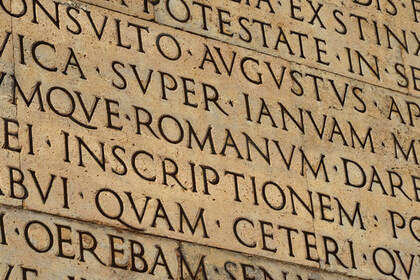
  • Inscriptions: Latin inscriptions are a ubiquitous feature of Roman art and architecture, providing context, dedications, and historical information. 
  • Inspiration for Art: Latin literature, including the works of Virgil, Ovid, and others, served as inspiration for artists throughout history, particularly during the Renaissance and subsequent periods. 
  • Language of Scholarship: Latin was the language of scholarship and learning in Europe for centuries, influencing artistic theory, criticism, and the transmission of artistic knowledge. 
  • Roman Influence on Art: The spread of Roman culture through the empire brought Roman artistic styles and techniques to various regions, often incorporating Latin inscriptions and themes. 
  • Medieval and Renaissance Art: Latin inscriptions continued to appear in medieval and Renaissance art, sometimes posing challenges for interpretation due to the evolving nature of the language and artistic styles. 
  • Modern Art: Modern and contemporary artists have also engaged with Latin, sometimes using it to explore themes of language, power, and cultural heritage. 
Examples
  1. Roman Mosaics: Latin inscriptions often adorned Roman mosaics, adding a layer of meaning and cultural significance to these works. 
  2. Renaissance Paintings: Renaissance paintings frequently featured Latin inscriptions, sometimes quoting classical texts or celebrating religious or historical events. 
  3. Sculptures and Monuments: Latin inscriptions were commonly found on Roman sculptures, sarcophagi, and public monuments, providing information about the subject, artist, or patron. 

Literature
​Latin and literature are deeply intertwined, as Latin was the language of a vast body of written works, particularly during the Roman Republic and Empire, and continued to be a significant literary language for centuries afterward. This body of work, known as Latin literature, encompasses various genres, including poetry, drama, history, and philosophy, with authors like Virgil, Cicero, and Ovid being prominent figures.

1. The Rise of Latin Literature
  • Latin literature emerged from the Roman adaptation and development of Greek literary models, beginning around 240 BC with the performance of the first Latin stage play. 
  • It flourished for roughly six centuries, roughly from the 2nd century BC to the 5th century AD, encompassing the Roman Republic and Empire. 
  • Key periods within Latin literature include Early Latin, the Golden Age (often associated with the Augustan period), the Imperial period, and Late Antiquity. 
2. Key Authors and Works
  • Cicero: known for his oratory, philosophical treatises, and letters, significantly shaping the development of Latin prose style, according to Britannica Kids.
  • Virgil: celebrated for his epic poem, the Aeneid, which tells the story of Aeneas's journey and the founding of Rome.
  • Horace: famous for his odes, satires, and epistles, Horace explored themes of love, nature, and morality.
  • Ovid: studied for his mythological narratives in the Metamorphoses and his poetry on love and seduction.
  • Others: Livy, Seneca, Tacitus
3. Themes
Diverse themes explored in Latin literature include
  • The pastoral ideal: a longing for a simpler, agrarian life, often contrasted with the complexities of urban life and war.
  • The relationship between civilization and barbarism: a recurring theme, particularly in historical and epic works, exploring the perceived differences between Roman culture and that of other peoples.
  • The nature of power and leadership: explored in works dealing with political figures and events.
  • Love, loss, and the human condition: explored in poetry and philosophical writings.​

Humanities
  • Philosophy and Theology: Latin was historically the language of philosophy and theology in the Western world, especially in the Catholic Church, and the language of Aquinas, probably the greatest philosopher in world history, having incorporated Aristotle, tutored by Plato, tutored by Socrates.
  • Documents in the Roman Church: Documents are still issued in Latin. It is the official language of the Holy See and the Vatican City State and is used for certain official documents, liturgical texts, such as the Roman Missal, and canon law.
  • Some documents: Documents like the Catechism of the Catholic Church can be drafted and published initially in a modern language (like French in the case of the Catechism) and then translated into Latin, which is considered the authoritative version, according to Wikipedia.
  • Linguistics and Etymology: Latin is the root of the Romance languages (Italian, French, Spanish, Portuguese, Romanian) and is the source of well over 50% of English words. Studying Latin enhances understanding of these languages and English grammar. (I believe the truth is that Latin generated over 80% of English words.)
  • History: Beyond its role in Classical Studies, Latin is valuable for studying medieval and early modern European history and American history. (We have the largest Latin Mass contingent and will not be defeated.)

Aviation
  • Origin of Aviation: The word "aviation" itself is derived from the Latin word avis, meaning "bird". This connection highlights the inspiration early pioneers took from observing birds in flight.
  • Aviation Terminology: Several aviation-related words have Latin or French origins (French has strong Latin roots):
    1. Fuselage, derived from the French word fuselé, meaning "spindle-shaped", reflecting the streamlined shape of the aircraft body.
    2. Empennage, referring to the tail assembly of an aircraft and coming from the French word empenner, meaning "to feather the arrow", highlighting its role in stability, according to Britannica Kids.

Historical Dominance
  • Technological and Economic Advancement: Western nations, particularly in Europe, led the way in technological innovation and industrialization for centuries, giving them a significant advantage in earthly power.
  • Political Influence: Western political ideologies like democracy and capitalism have spread globally, becoming dominant in many regions.
  • Cultural Diffusion: Western culture, including arts, entertainment, and consumerism, has been widely adopted and adapted in other parts of the world, facilitated by advancements in communication and transportation.

School
Latin was taught throughout school systems of the Western world, including the mission countries of Asia, until the end of the 1950s.

🛡️ "Canes Belli - Legio Secunda Sabina" – Epic Latin March 🗡️ Step into the ancient world with "Canes Belli ", a powerful Latin military march honoring the legendary Legio Secunda Sabina. This original composition brings to life the discipline, honor, and courage of Rome’s warriors. Perfect for fans of epic music, historical reenactment, and classical Latin culture. Made using AI and different music and video mastering programs. Original lyrics! All Rights Reserved! You can share it but you must link this channel. Thank You!
​
History Through Sounds 
@HistoryThroughSounds-v7e
​CC for the English translation
Dogs of War
​
​


comments from Latin teachers/students/choristers/seminarians/priests welcome
1 Comment

penitentiary

8/8/2025

0 Comments

 
A prison is often called a penitentiary. What is the derivation? Latin. Penitential, or penance, to be sorry, to pay for what you've done, to do something to repay the debt.
0 Comments

21 hospitals halted

7/28/2025

0 Comments

 
United States
7/25/2025

Trump ended ​gender-affirming care services at 21 hospitals.

www.whitehouse.gov/articles/2025/07/president-trump-promised-to-end-child-sexual-mutilation-and-he-delivered/

Included is Kaiser Permanente.

Wikipedia summary
Kaiser Permanente is an American integrated managed care consortium headquartered in Oakland, CA. Founded in 1945 by industrialist Henry J. Kaiser and physician Sidney R. Garfield, the organization was initially established to provide medical services at Kaiser's shipyards, steel mills, and other facilities, before being opened to the general public.

Kaiser Permanente operates as a consortium comprising three distinct but interdependent entities: 1) the Kaiser Foundation Health Plan (KFHP) and its regional subsidiaries, 2) Kaiser Foundation Hospitals, and the 3) regional Permanente Medical Groups. Kaiser is in eight states, California, Colorado, Georgia, Hawaii, Maryland, Oregon, Virginia, and Washington, as well as the District of Columbia, and is the largest managed care organization in the US.

Consortium
The word "consortium" originates from the Latin word consors, meaning partner or sharing in property. The word itself is derived from con- (together) and sors (fate), suggesting a shared destiny or purpose. A consortium is a partnership or association where members pool resources to achieve a common goal.​
Picture
commons.wikimedia.org/wiki/File:One_Kaiser_Plaza.jpg
0 Comments

richest churches

7/19/2025

0 Comments

 
United States
​
4) Church of Scientology $2.0 billion
HQ Gold Base, Riverside CTY, CA
founded 1954

3) Trinity Church (Episcopal) $6.0 billion
HQ New York City, NY
founded 1697

2) Seventh-day Adventist Church $15.6 billion
HQ Silver Springs, MD
founded 1863
​

1) Church of Jesus Christ of Latter-Day Saints $293.0 billion
HQ Salt Lake City, UT
​founded 1830

Notes
1) Catholic Church not founded here
2) wealth incalculable, debt growing
3) calendar began again at His birth


Latin words

1) Roman Romanus
2) Catholic catholica
3) founded fundare
4) united unitum
5) states status
6) lord dominus
7) church ecclesia
8) calendar calendarium
9) began incipio, as in the noun inception
10) again iterum, as in reiterate
11) birth nativitas as in novice
12) wealth pecunia, as in pecuniary
13) i
ncalculable inaestimabilis
14) debt debitum
15) growing crescente, as in crescendo


​from the court of QM I
died AD 30s Jerusalem, outside the walls, like Paul Outside the Walls
0 Comments

wolf in Latin

7/1/2025

0 Comments

 
The little man has one advantage: he hears Mandarin.
​Alexander wrote, "Versipellis est lapidea." The wolf is made of stone.
His amanuensis wrote, "Versipellis cōnspexit." I caught sight of the wolf.
Versipellis means shape-shifter, double-dealer, and figuratively it means sly, cunning, crafty, which emphasizes the importance of translators and interpreters, who go through rigorous training.
0 Comments

protestant Mass held

6/8/2025

0 Comments

 
United States
​
Our Lady of Lourdes Church, Oakland, CA
The priest is called the presider.
Our Lord's suffering is greatened. Our Lady's pain is magnified.
no sanctuary, tabernacle, kneelers, crucifix on an altar; table; 
"gathering"; barren (two children); masks still worn (political statement); women reading the "Word of the Lord"; sermon not given from the pulpit; congregational participation; "for the kingdom, the power, and the glory" not part of the Our Father; woman holding a chalice; Body of Our Lord touched by so-called Eucharistic ministers and taken by the hand while standing, not received on the tongue while kneeling before Him in His presence; no silence; conversations

Subscribe to a new, comprehensive examination of Church history beginning immediately after the Ascension 
@historiaecclesiastica (YT).
14.3K subscribers
112 videos

St. Benedict Catholic Church, Chesapeake, VA
0 Comments

KRONOS 1957

6/6/2025

0 Comments

 
United States
recommended by John Smith in a blog comment Sharp Centre
Golden Dome
  • ​KRONOS Greek Titan and destructive god of time
  • CRONUS or SATURNUS, Roman equivalent, aka Saturn, Saturday
  • Who worships on Saturday? Jews, Adventists, some Mormons
  • Who worships on Sunday? Latin Mass Catholics (and daily Mass)
  • Son derives from the Proto-Indo-European root, suHnús, meaning "son", which is derived from sewH-, meaning "to bear, give birth".
  • Sun derives from the Proto-Indo-European root, s(u)wen-, meaning "sun", which is related to words for "brightness" or "light".
  • Science fiction often reveals truth.
Every day I count my lucky stars and the Star of the Sea.
0 Comments

Solfeggio invented

6/4/2025

0 Comments

 
Western music
https://en.wikipedia.org/wiki/Guido_of_Arezzo​
  • Guido of Arezzo (c. 991–992 – after 1033), Benedictine monk, was an Italian music theorist and pedagogue of high medieval music. He is the inventor—or by some, developer—of modern staff notation that had a massive influence on the development of Western musical notation and practice.
  • AI says Paul the Deacon, Benedictine, wrote Ut queant laxis.

​Ut queant laxis resonare fibris translates to "So that with loosened voices, they may resound" or "So that with loosened cords, they may resound". The hymn is famous for its use of the syllables "ut, re, mi, fa, sol, la" to teach the notes of the musical scale. As we know, monks were the first educators of priests.
0 Comments

safe places

6/2/2025

0 Comments

 
Phoenix
​
home, classroom, church
​
sanctuaries without any secrets
​When spoken, a secret is not a secret.
0 Comments

hating Trump

5/16/2025

0 Comments

 
Worldwide
​Some people hate Trump. The man is doing great things for others, and one is left wondering why the hate, which is a question I never ask and answer. The man who met Christ on the road to Damascus answers.
​
16 But all do not obey the gospel. For Isaias saith: Lord, who hath believed our report?
17 Faith then cometh by hearing; and hearing by the word of Christ.
18 But I say: Have they not heard? Yes, verily, their sound hath gone forth into all the earth, and their words unto the ends of the whole world.
19 But I say: Hath not Israel known? First, Moses saith: I will provoke you to jealousy by that which is not a nation; by a foolish nation I will anger you.
20 But Isaias is bold, and saith: I was found by them that did not seek me: I appeared openly to them that asked not after me.
21 But to Israel he saith: All the day long have I spread my hands to a people that believeth not, and contradicteth me.
Psalm 50
Miserere. The repentance and confession of David after his sin. The fourth penitential psalm.

​https://www.drbo.org/chapter/21050.htm
0 Comments

Dies Irae choose sides

5/11/2025

0 Comments

 
Religion
​There are two Churches in the world today and nothing that will reconcile them. I can no longer call one of them Catholic.

I once heard Bishop Robert Barron say that he hopes no one is in Hell. Barron is an idiot. By betraying Jesus for 30 pieces of silver and then committing suicide over the remorse for doing it and never asking Jesus to forgive him, Judas condemned himself to Hell. Everyone with a brain knows this is what happened. It has become fruitless and joyless to continue listening to, or having conversations with, invincible idiots.
​

Politics
There are two worldviews in the world today and nothing that will reconcile them. I can no longer call one of them American.

​Third Sunday after Easter
Introit Ps. 65, 1, 2 Shout with joy to God, all the earth, alleluia; sing ye a psalm to His name, alleluia: give glory to His praise, Alleluia, alleluia, alleluia. Ps 65, 3 Say unto God, how terrible are Thy works, O Lord! in the multitude of Thy strength Thy enemies lie to Thee.​

I'm going to be frank with readers. If you don't know Latin, you will never fully understand English, or the Catholic faith, if you possess it, and never get close to Sts. Peter and Paul. How can you, if you don't speak at least one of their languages?

​What words did they speak when consenting to their martyrdoms? If you were there, what then? If you didn't speak Latin, how could you pass the word?


Yesterday, I told Drayson (13) that these are real men, not statues, and that if I get to Heaven, I will ask to meet them.
Read 
Romans & Christ.

Then again, for some of you I guess language doesn't mean much. Perhaps, you can manage wordless, silent prayer.

Every Latin word in the poetic warning has an English equivalent.
Example 1: stúpebit - stupefied - translated as "will marvel"
Example 2: iudex - Jew/judge Book of Judges Bible
Example 3: favilla - flagrant, conflagration
Example 4: ov (oves) - ovum (related)
Example 5: solvet - solve, solvent
Example 6: saeculum - century
Example 7: quaerens - query

Example 8: spargens - spar
Example 9: cassus - casual
18 stanzas of rhyming triplets
Do you realize how much time it took to compose the poem, how much effort Mr. Lenk exerted to prepare, design, and record the poem, and how much repetitive listening it took me to count the triplets?

Consider that an invitation.
5461 44th Street, Sacramento, CA

4524 Garfield Avenue, Carmichael, CA

0 Comments

Jeremiah laments

5/8/2025

0 Comments

 
Old Testament Book of Jeremias, Latin with English subtitles
​ https://www.drbo.org/chapter/28001.htm
Saint Jerome translated the Old Testament into Latin. His translation, which also included the New Testament, became the standard Latin version of the Bible and is known as the Vulgate. Jerome completed this work between AD 383 and 404. He used Hebrew and Greek manuscripts for his translations.
​
The Douay-Rheims translators completed their work on the Vulgate in 1582 and 1609-1610, giving us the first English Bible. Bishop Richard Challoner (1691 - 1781), a leader of English Roman Catholics, made some revisions to the Douay, and it became the authorized edition for English Catholics.


0 Comments

Latin improving

5/6/2025

0 Comments

 
Alexander's Lesson 4
We spend about 10 minutes on Latin at each session.
He was able to write: Senex in taberna sanguis fluit.
The old man in the shop was bleeding.​
Picture
drawing courtesy of Cambridge Latin Course Unit 1
English roots
senex - senile
taberna - tavern
sanguis - sanguine
fluit - flow

Take a peek at “Just Lather, That’s All”.
​
0 Comments

who is our bulwark

4/27/2025

0 Comments

 
Picture
This is meant for all those who recoil at military terms: munimen noun.

0 Comments

Easter 2025

4/20/2025

0 Comments


​Athanasian Creed

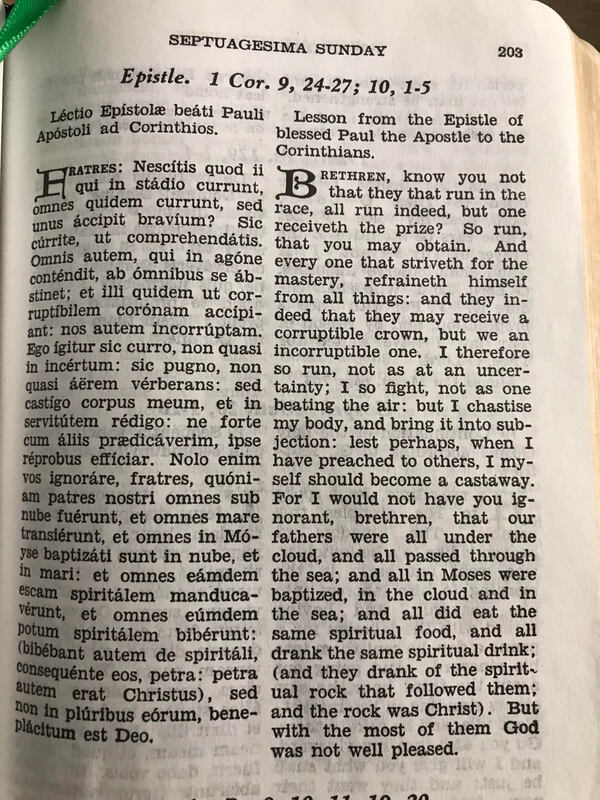
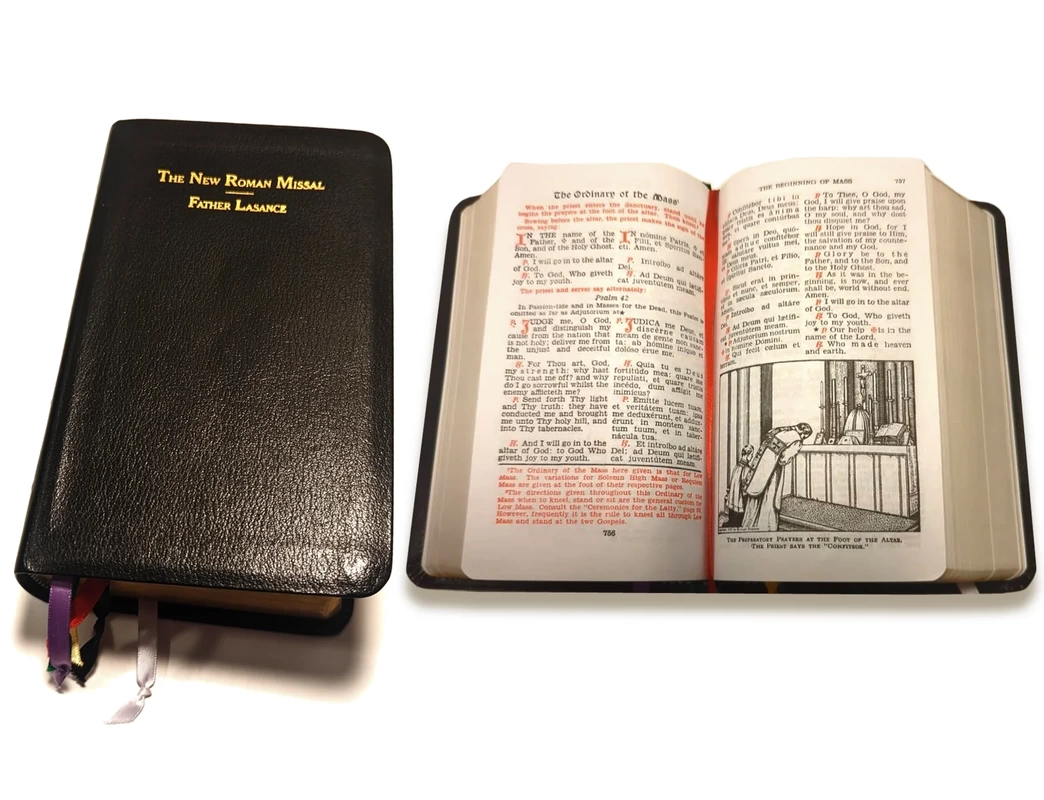
The creed comes right after The Preface and before The Sanctus, pp 773-774 of the Father Lasance Edition, 1962 Missal, Nihil Obstat 1937, Imprimatur 1945.

The creed was deleted by fiat in 1969 and thus, is, joylessly absent from the Novus Ordo Mass.


Latin, Father of All Romance Languages and English

Some will say that Latin is not an essential part of the Mass or anything else. However, Latin has given me a better understanding of the language I speak and write every day, and a grasp of English is a critical part of the thousands of hours expended developing this website.

Moreover, an understanding of Latin will assist a concentration in English and reading fine literature. Prior to the middle of the last century, all or most American and British students were reading Latin. ​There is no manipulating a static language. Manipulating English is constant.
0 Comments

Psalm 42 tomorrow

4/5/2025

0 Comments

 
Picture
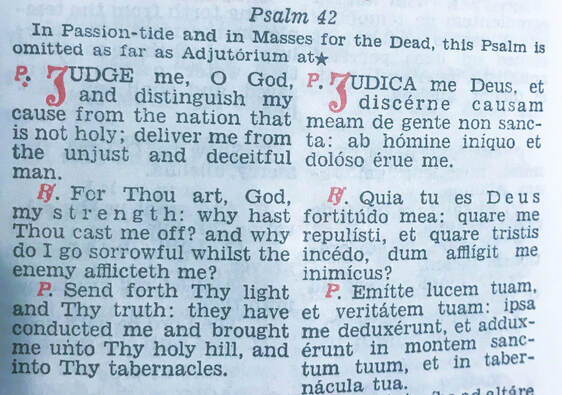
Psalm 42 is contained in the Prayers at the Foot of the Altar every day, and these prayers are not in the New Order Mass, nor is this psalm in the New Order Passion Sunday Mass, which is called the Fifth Sunday of Advent. These things are 1969 casualties, when "judgment" and "passion" were thought to be too harsh. How do I know what is missing from the New Order? I called a friend.

Notice how Latin changes ever so slightly the words for "conducted" and "brought". Also, notice the marks above Latin words with more than two syllables that are there to help you know which syllable is stressed.

My friend told me that the last time she went, there were 10 people. So, continue going to the bonanza Mass.
​
0 Comments

the Archangel

3/27/2025

0 Comments

 
The Leonine Prayers, a set of prayers recited after Low Mass, were ordered by Pope Leo XIII and consist of three Hail Mary's, a Hail Holy Queen, a prayer to St. Michael, and a threefold invocation to the Sacred Heart.

The St. Michael is repeated to afford you a view of many commissioned sculptures and art. A life-size sculpture is at St. Michael in Carmichael, CA.
​
Here is another from the SSPX.
​
Picture
9 When Michael the archangel, disputing with the devil, contended about the body of Moses, he durst not bring against him the judgment of railing speech, but said: The Lord command thee The Epistle of Jude is the penultimate book of the New Testament. Jude Thaddeus is one of the twelve apostles.
0 Comments

constellations?

3/19/2025

0 Comments

 
Constellation: any of certain groupings of stars that were imagined—at least by those who named them—to form conspicuous configurations of objects or creatures in the sky; useful in assisting astronomers and navigators to locate certain stars -Britannica
Picture
image Northern Hemisphere
​The base word, zodiac, comes from the Greek zōidiakòs (kuklos), meaning “(circle) of signs”. It ultimately comes from zōidion, meaning “animal sign” or “carved figure”, from zōion, “animal”. The word constellation comes from the Late Latin constellātiō, from Latin com-, meaning “together”, and stella, meaning “star”.


0 Comments

English solved

2/15/2025

0 Comments

 
The modern Latin alphabet evolved from a combination of Anglo-Saxon runes and the ancient Latin script. In the fifth century, the Anglo-Saxons arrived in the British Isles and brought with them an alphabet that formed the basis for the Old English language.

​Later, in the seventh century, the Latin script, which is more reminiscent of the alphabet we use today, was introduced throughout the region.

Latin and Old English were used concurrently for several centuries until the latter evolved into Middle English circa the early 11th century. Around this time, a hybrid alphabet emerged, consisting of 23 of the standard letters we still use today, plus three runic symbols to represent the sounds “th,” “wy,” and “eth.” [quare became why]

​The runic symbols eventually fell out of use, and the letters “U” and “W” were added to the Latin alphabet in the Middle Ages. Finally, in the 1600s, the 26th and final letter was added: “J.” [Iesus became Jesus]

courtesy of wordsmarts.com


0 Comments

FR 5th Sunday After

2/9/2025

0 Comments

 
This is Saint-Nicolas-du-Chardonnet, SSPX, Paris.
We have 110 well-trained altar boys, FSSP, Sacramento.
Our Father in Latin
PATER NOSTER, qui es in caelis, sanctificetur nomen tuum. Adveniat regnum tuum. Fiat voluntas tua, sicut in caelo et in terra. Panem nostrum quotidianum da nobis hodie, et dimitte nobis debita nostra sicut et nos dimittimus debitoribus nostris. Et ne nos inducas in tentationem, sed libera nos a malo.
...but deliver us from evil.

Green - hope
​
A priest is not a career man. Such a man is dedicated to his career and is willing to do whatever it takes to advance, even if it means compromising his integrity. The priest will be seen as priest in the next life, through eternity. How blessed is that man.
​
Here is a long list of SSPX schools in France:

https://laportelatine.org/lieux?current_post_id=233404&post_id=1670&form_id=8c37782&typelieu=51​

0 Comments

Ad astra per aspera

2/4/2025

0 Comments

 
Ad astra per aspera, Domine,
​To the stars through hardship, O Lord,

Our journey is strengthened by faith. Iter nostrum in fide firmatur.
Have mercy on us, King of Glory,         Miserere nobis, Rex gloriae,
And guide us into your light.               Et dirige nos in lumen tuum.
We shall not fear adversity,                 Non timebimus adversa,
For you are our strength.                     Fortitudo nostra es tu.
May your glory shine upon us,            Gloria tua refulgeat super nos,
And may your peace reign forever.     Et pax tua regnet in saecula.
Blessed are you, O mighty God,          Benedictus es, Deus potentiae,
Who leads your people.                      Qui ducis populum tuum.
In darkness we shall not falter,          In tenebris non deficiemus,

Quia lux tua splendet in aeternum.​
For your light shines eternally.         

0 Comments

Dum spiro spero

1/29/2025

0 Comments

 
Dum spiro spero, Domine,
In te confido et sperabo semper.
Da mihi virtutem et pacem,
Adversis in temporibus sustinere.
Lumen tuum dirige me,
Spes aeterna cor meum imple.
Fiduciam habeo in misericordia tua,
Et semper laudabo nomen tuum.


While I breathe, I hope, O Lord,
In you I trust and will always hope.
Grant me strength and peace,
To endure in times of adversity.
Guide me with your light,
Fill my heart with eternal hope.
I trust in your mercy,
And will always praise your name.
You are hearing an American Catholic's pronunciation.
​Ad victoriam vel mortem, sine metus Toward victory or death, without fear

0 Comments
<<Previous
Forward>>

    RSS Feed

    Categories

    All
    Art
    Comedy
    Crime
    English
    Faith
    Film
    History
    Latin
    Math
    Music
    Photography
    School
    Science

    Archives

    July 2026
    June 2026
    May 2026
    April 2026
    March 2026
    February 2026
    January 2026
    December 2025
    November 2025
    October 2025
    September 2025
    August 2025
    July 2025
    June 2025
    May 2025
    April 2025
    March 2025
    February 2025
    January 2025
    December 2024
    November 2024
    October 2024
    September 2024
    August 2024
    July 2024
    June 2024
    May 2024
    April 2024
    March 2024
    February 2024
    January 2024
    December 2023
    November 2023
    October 2023
    September 2023
    August 2023
    July 2023
    June 2023
    May 2023
    April 2023
    March 2023
    February 2023
    January 2023
    December 2022
    November 2022
    October 2022
    September 2022
    August 2022
    July 2022
    June 2022
    May 2022
    April 2022
    March 2022
    February 2022
    January 2022
    December 2021
    November 2021
    October 2021
    September 2021
    August 2021
    July 2021
    June 2021
    May 2021
    April 2021
    January 2021
    December 2020
    October 2020
    September 2020
    August 2020
    July 2020
    August 2018
    July 2018
    June 2018
    May 2018
    April 2018

Proudly powered by Weebly
  • Search robertedunn.com/blog
  • Unidentified Anomalous Phenomena
  • CRIME BLOG
  • Blog
  • Author
  • Pretty City Murder
  • Chapter 1
  • Contact
  • Short Stories
    • Deaf
    • Anonymous
    • Isolated
    • Apartment 19
    • Letters
    • Phantasmal
  • True Stories
    • Talk
    • Heel
    • Priest
    • Best
    • Sweet
    • Father
  • Piano
  • Servile Obedience
  • Society of St. Pius X
  • How It Happened
  • Website Stats
  • Latin Mass in History
  • Reading List
  • Mass of the Ages